PME MTL Centre-Ouest dessert les entrepreneurs des arrondissements d’Ahuntsic-Cartierville et Saint-Laurent et les villes de Côte-Saint-Luc, Hampstead, Montréal-Ouest et Mont-Royal.
PME MTL Centre-Ouest dessert les entrepreneurs des arrondissements d’Ahuntsic-Cartierville et Saint-Laurent et les villes de Côte-Saint-Luc, Hampstead, Montréal-Ouest et Mont-Royal.
When growth starts to level off, the first step isn't launching a new marketing campaign or introducing a new product. It's understanding why revenue has stalled.
Once the underlying cause is clear, businesses can choose the right path forward: expanding their offer, entering new markets, increasing sales to existing customers or growing their production capacity.
Key Takeaways
Recognize the warning signs: it takes more effort to generate the same sales, and acquiring new customers becomes more expensive.
Avoid two common mistakes: investing in marketing too quickly and expanding your offer too soon.
Start with a diagnosis: identify whether you're addressing a real market need, reaching the right audience and making the most of your current offer.
Consider four growth strategies: offer diversification, geographic expansion, cross-selling and increased production capacity.
Take emotion out of the equation: use data and market insights to guide decisions.
Why Do Business Revenues Eventually Plateau?
At some point, most businesses experience a period when growth slows down. It's a natural stage in the business lifecycle. The same efforts generate fewer results, the sales pipeline stops growing, and maintaining momentum requires a new approach.
According to Souad Laidi, Director, Commercial Innovation at PME MTL, the first warning sign isn't always declining revenue. Often, it becomes harder to achieve the same sales results. Customer acquisition costs rise, marketing campaigns become less effective, or growth becomes increasingly dependent on a small number of clients.
This situation creates real pressure. A business that was growing by 5% or 10% each year suddenly sees revenue flatten. The temptation is to act quickly and implement any solution that promises results.
That's often when fear drives decision-making. Businesses try to do everything at once and lose sight of what matters most: understanding their customers.
What Mistakes Should You Avoid When Sales Slow Down?
When growth begins to stall, some business owners feel pressure to act quickly. Yet the wrong response can make the situation worse rather than better.
One common pitfall is launching new marketing initiatives before identifying the root cause of the slowdown. While marketing can be a powerful growth driver, it is most effective when guided by a clear understanding of the challenge at hand.
"If marketing dollars are invested in the wrong target audience, the result is often a more complex problem rather than a solution," says Souad Laidi.
Another risk is reacting by adding new products or services without a clear strategic rationale. In an effort to reach a broader audience, businesses can end up weakening their positioning and blurring what makes them distinct in the marketplace.
At the heart of both mistakes is the same misconception.
"Some entrepreneurs confuse speed with progress. Moving quickly can feel like moving forward, but when the wrong decisions are made, it can actually set the business back."
How Do You Diagnose the Problem Before Taking Action?
A good diagnosis starts with three questions:
Question 1
Does your product or service solve a real customer problem?
Question 2
Are you targeting the right audience?
Question 3
What can you improve within your existing offer before creating something new?
Analyze Your Market and Define Your Positioning
Before spending a dollar on marketing, take a step back and assess what's working and what isn't.
Then comes the analysis:
What is performing well and why?
What is underperforming and why?
What is your target audience actually looking for?
What differentiates your business from competitors?
It's also important to look beyond your own organization. Are competitors facing similar challenges? Are they doing something differently?
The goal isn't to copy them. It's to understand the market around you.
Many businesses that work with PME MTL discover they haven't thoroughly analyzed their market. That's often where the process begins: evaluating market potential and learning from companies that have succeeded as well as those that haven't.
What Are the Best Strategies for Increasing Revenue?
There is no single solution that works for every business. The right strategy depends on the diagnosis.
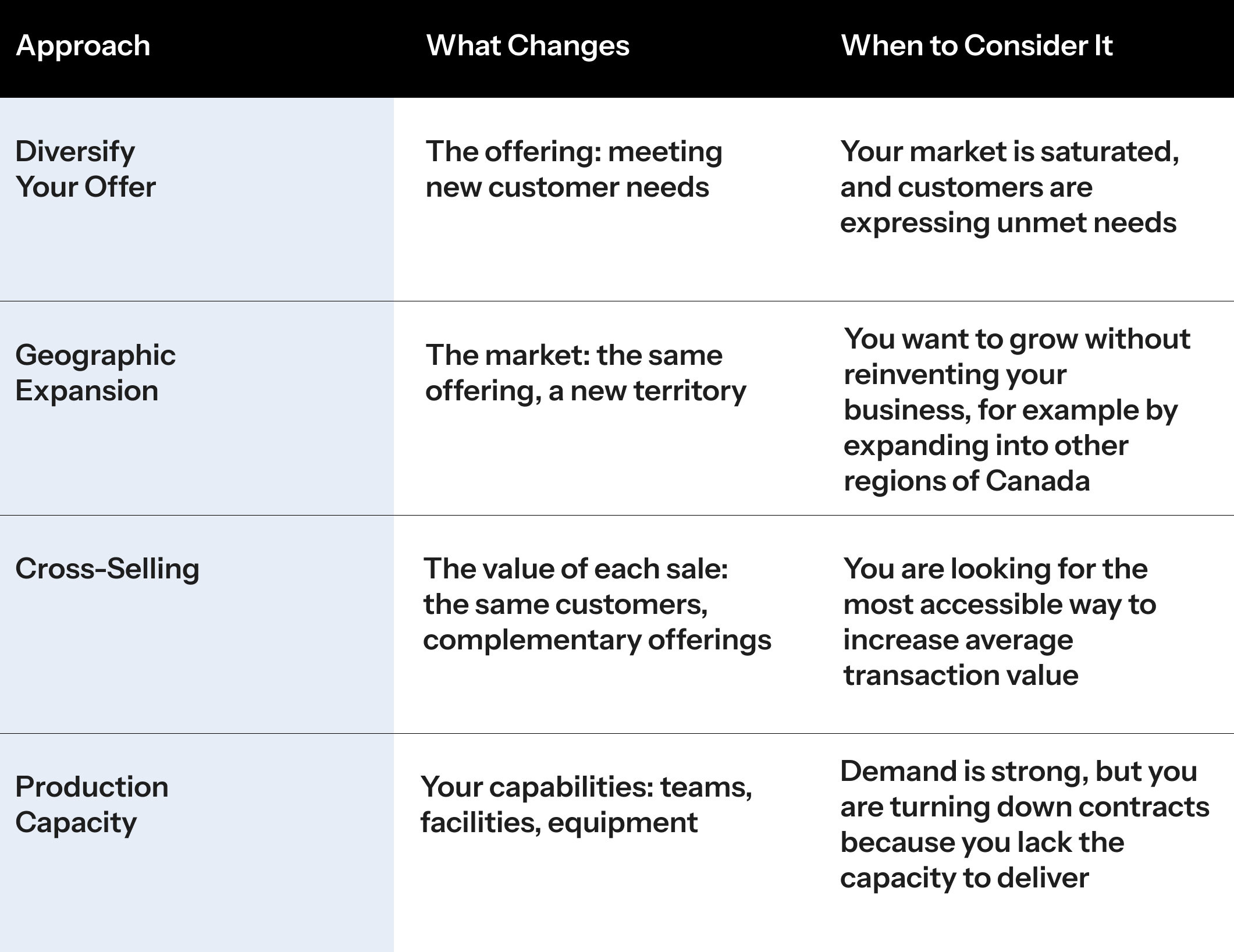
Four approaches are commonly used to drive growth:
1. Diversify Your Offer
This strategy involves introducing new products or services to address needs that are currently unmet.
It is most effective when customers are expressing needs that your business doesn't yet serve, or when competitors are not fully meeting market demand.
Success depends on finding the right balance. Expanding too far, too quickly can weaken your positioning and dilute your expertise.
2. Expand into New Markets
Geographic expansion allows businesses to grow without fundamentally changing their offer.
For many Montréal businesses, this may mean exploring opportunities outside Québec or elsewhere in Canada.
The advantage is simple: the business keeps its existing expertise while gaining access to new customers.
3. Increase Revenue Through Cross-Selling
Cross-selling is often the most accessible growth strategy because it doesn't require a new customer base or a new offer.
For example, recommending a shirt to a customer purchasing a pair of pants can increase average transaction value while improving conversion rates.
By helping customers discover complementary products or services, businesses can generate more value from existing relationships.
4. Increase Production Capacity
For some businesses, the challenge isn't demand. It's the ability to meet it.
Growth may be limited by staffing levels, facilities, equipment or operational processes.
As Souad Laidi explains:
"For some businesses, the real obstacle to growth isn't sales demand. It's their ability to fulfill that demand."
In these situations, growth starts with expanding operational capacity, which may require financing to support investments in people, equipment or infrastructure.
Where Should You Start?
The first step is understanding your business:
Why are sales no longer growing as they once did?
Why are previous strategies becoming less effective?
Does the issue stem from the product, the message or the market?
Once these questions have been thoroughly explored, the path forward becomes much clearer.
When growth slows, stress is a natural reaction. Souad Laidi's advice is straightforward: set emotions aside, look at the data, understand the competitive landscape and take time to analyze the situation before making major decisions.
The businesses that succeed over the long term tend to share one characteristic: they think strategically before acting. Rather than constantly reacting to short-term challenges, they build for sustainable growth.
Through PME MTL's Commercial Innovation Program, businesses can access specialized support to overcome growth challenges, explore new markets and strengthen their commercialization strategies.
FAQ
My business relies heavily on U.S. sales. What should I do?
Many businesses supported by PME MTL generate a significant share of their revenue in the United States. Before investing in new products or services, consider expanding into new Canadian markets. Provinces such as Ontario and Western Canada may offer growth opportunities, but market research is essential because customer needs and buying habits can vary considerably.
How can I evaluate the potential of a new market?
Start by assessing the size of the opportunity. Is the market worth $10,000 a year or $100 million?
Next, analyze businesses that have successfully entered the market as well as those that have struggled. Understanding the decisions they made can help you identify opportunities and avoid common pitfalls.
What is resource sharing between businesses?
Resource sharing allows businesses to collaborate by pooling assets and capabilities.
For example, two companies operating from the same building may be able to share resources if their peak periods occur at different times of the year. Businesses can also join forces when purchasing from suppliers, increasing their buying power and reducing costs.
Contact your local PME MTL service centre so we can help you identify the strategy best suited to your situation and connect you with the financing and expertise needed to move your business forward.
PME MTL Centre-Ouest dessert les entrepreneurs des arrondissements d’Ahuntsic-Cartierville et Saint-Laurent et les villes de Côte-Saint-Luc, Hampstead, Montréal-Ouest et Mont-Royal.