PME MTL Centre-Ouest dessert les entrepreneurs des arrondissements d’Ahuntsic-Cartierville et Saint-Laurent et les villes de Côte-Saint-Luc, Hampstead, Montréal-Ouest et Mont-Royal.
PME MTL Centre-Ouest dessert les entrepreneurs des arrondissements d’Ahuntsic-Cartierville et Saint-Laurent et les villes de Côte-Saint-Luc, Hampstead, Montréal-Ouest et Mont-Royal.
The objective of market research is to verify that a market exists, that there are customers, and that there is potential demand before launching a business.
More specifically, market research helps you understand:
the dynamics of your industry;
customer behaviour;
competitors' business models;
your competitive advantage.
By relying on concrete information rather than assumptions, you can define a clear market position. That is exactly what market research is for.
Conducting market research does not necessarily require a large budget or the support of an external consultant. On the contrary, your involvement is essential because no one understands your project, objectives, and initial assumptions better than you do.
The key is to start with your assumptions, then determine what information you need, which research methods to use, and which data to analyze.
Key Takeaways
The biggest challenge is access to information, not budget.
Entrepreneurs often say, "There is no competition." Yet, when you look closely, there almost always is. Competition is often proof that a market exists.
Competitors are one of the most accessible sources of information because they already operate in the market.
To target is to choose: a niche, a neighbourhood, or a customer segment.
Field research confirms whether an opportunity truly exists.
Markets evolve constantly. Market research is an ongoing mindset, not a one-time task.
Questions to Ask
Why?
To assess whether your idea addresses a real need and to reduce risk.
What should you analyze?
Your industry, competitors' business models, and customers' needs and expectations.
How?
Through surveys, interviews, field observations, and conversations with competitors, partners, customers, suppliers, and industry experts.
Who should do it?
Primarily the entrepreneur, with support from PME MTL. Industry experience is valuable, but it does not replace the exercise.
When?
Before launching your business, but also throughout the life of the company.
Three factors often prevent entrepreneurs from conducting market research: they believe they need to hire a consultant, do not know where to start, or assume they already know everything about their market. Yet even experienced entrepreneurs benefit from testing their assumptions.
Industry experience is certainly an advantage because it provides real-world knowledge. However, markets evolve constantly, so conducting market research remains a strategic exercise regardless of your experience level.
Where Should You Start?
Define Your Industry to Better Understand the Market
Start by answering these five questions:
What do you already know, and what still needs to be validated?
Is the market growing, stable, or declining?
Are there regulations governing this industry?
What sustainable business practices are emerging?
Which technological innovations are reshaping the market?
The starting point is publicly available information found online, on social media, in recent news articles, and in industry reports.
This secondary data, produced by third parties, often provides valuable information about market size, competitors, trends, and regulations. However, it rarely tells you much about customers in a specific neighbourhood or their actual needs.
At this stage, the main risk is spending too much time reviewing secondary data instead of gathering primary data directly from customers, competitors, and other market stakeholders.
Observe and Speak with Competitors: Your Most Accessible Source of Information
The presence of competitors indicates that a need exists. A few searches are usually enough to identify the main players in your market.
There are two types of competitors:
Direct competitors, who offer products or services similar to yours.
Indirect competitors, who offer different solutions but address the same customer need.
Competitor analysis is a goldmine of information. It helps you understand the market and identify opportunities to differentiate yourself.
Ask yourself:
What are they selling?
Who are they serving?
What are their pricing strategies?
Which sales channels do they use?
How active are they on social media?
What are the strengths and weaknesses of their business model?
Useful approaches include:
Following their social media channels and monitoring comments;
Visiting their store or place of business;
Testing their products or services;
Approaching them for collaboration or mentorship opportunities;
Acting as a mystery shopper.
The goal is not to copy competitors. It is to avoid starting from scratch by learning what works, what does not, and where innovation opportunities exist.
Studying their customers will also help you better understand your own.
The founder of the Montréal-based technology company Photon etc. explains how he chose between several potential markets in the video Finding the Right Market for Your Product Launch.
Identify Your Ideal Customer and Your Non-Customers
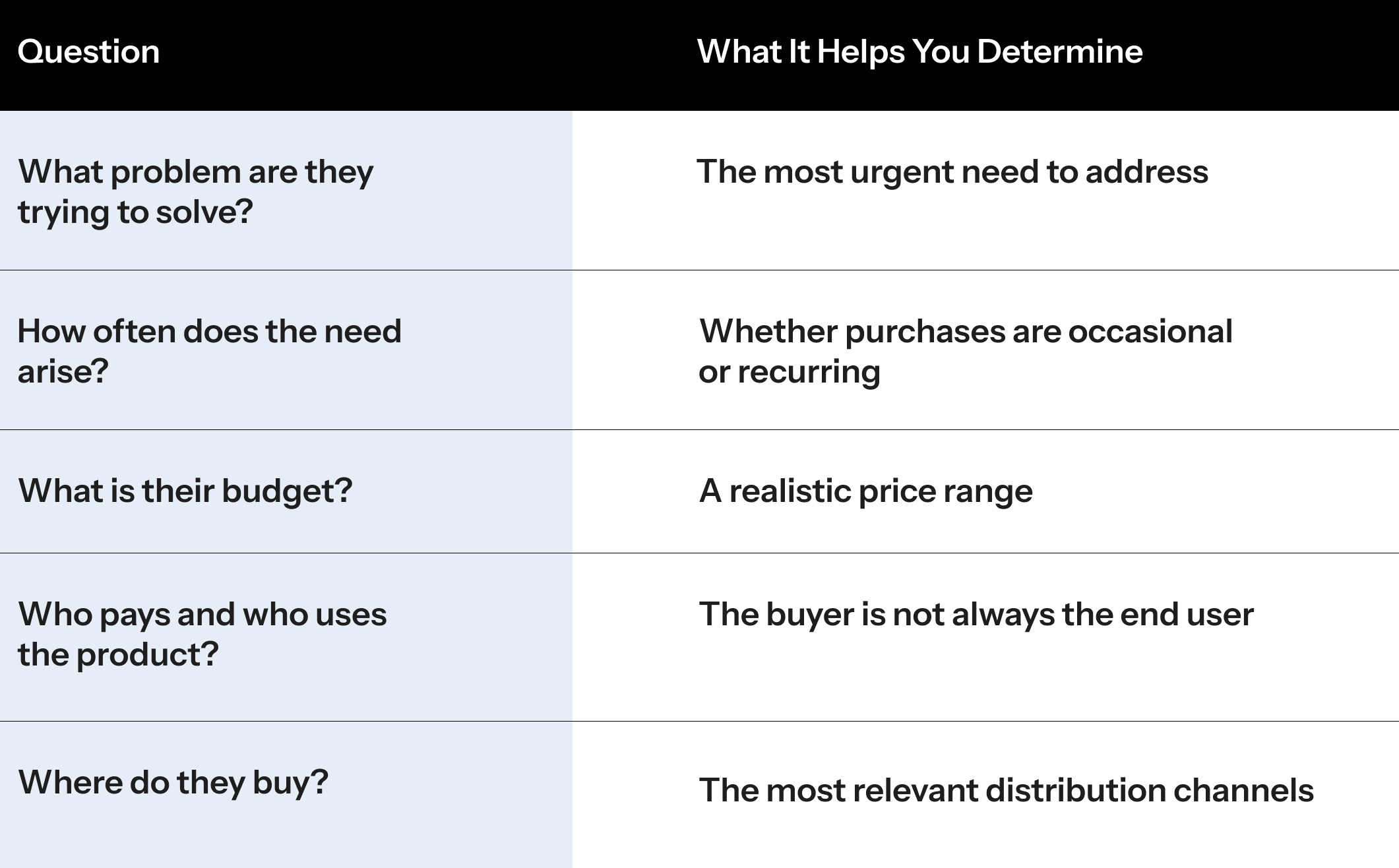
Analyzing competitors helps you understand the customers they serve. The next step is to define your own target customer based on an initial hypothesis and validate it by answering five essential questions.
5 Questions to Go Further
Who Should You Talk To?
Primary data comes from conversations. Five to ten interviews are enough to start identifying patterns.
Suppliers and complementary partners, to learn about industry practices and emerging challenges.
Indirect competitors, who can provide market insights without direct rivalry.
Experienced entrepreneurs, who can share lessons learned and, in some cases, provide mentorship.
Retired industry professionals, who can offer historical perspective and valuable context.
These conversations do more than validate demand. They also reveal effective sales channels and messaging approaches.
Give people a reason to meet with you, whether it is discussing a trend, exploring a partnership, or sharing industry knowledge. If you approach a competitor, clarify that you are not targeting their territory or customer base.
A simple message can be enough:
"Hello, I am preparing to launch a business and would greatly value your perspective on the industry. Would you be available for a 20-minute informal conversation at a time that works for you?"
Focus on listening rather than selling. Expect to contact several people. Then compare what you hear with industry data and statistics.
6 Common Mistakes to Avoid and How to Address Them
Staying in the "I think" mindset
Treat every assumption as something to validate
Thinking in terms of market share percentages
Define a realistic customer acquisition target for your first year
Trying to sell to everyone
Choose a niche, neighbourhood, or customer segment
Focusing only on broad trends
Work your way down to specific customer needs
Relying on a single source of information
Combine web research, customer interviews, competitor analysis, and supplier insights
Never reaching a conclusion
Set a clear objective, then make a decision
Four First Steps to Conduct Market Research
Write down everything you already know about your market.
Identify your competitors and observe them as a customer would.
Diversify your sources of information, then stop and make decisions.
Integrate your findings into your business plan.
Understanding your market is like preparing for a trip to an unfamiliar country: you gather information beforehand, but you truly learn once you get there.
Do not remain stuck in assumptions or wishful thinking. Test your ideas against reality.
FAQ
Is market research expensive?
No. Most of the essential resources are free: industry reports, competitor websites and social media channels, conversations with customers, suppliers, and industry professionals.
PME MTL can also help entrepreneurs structure their market research process.
How long should market research take?
There is no fixed timeline. Markets constantly evolve. Market research should become an ongoing habit rather than a one-time exercise.
How do you know whether to move forward or pivot?
Market research helps answer that question. If you find customers willing to pay, credible profitability potential, and a sustainable market position, it is time to move forward.
If the signals are contradictory, it may be necessary to revisit your offer and target customer segment before proceeding.
PME MTL Centre-Ouest dessert les entrepreneurs des arrondissements d’Ahuntsic-Cartierville et Saint-Laurent et les villes de Côte-Saint-Luc, Hampstead, Montréal-Ouest et Mont-Royal.