The Charter of the French language and its regulations govern the consultation of English-language content.

Support for businesses facing customs tariffs

  • 1 PME MTL Ouest-de-l'Île
    2 PME MTL Centre-Ouest

    PME MTL Centre-Ouest dessert les entrepreneurs des arrondissements d’Ahuntsic-Cartierville et Saint-Laurent et les villes de Côte-Saint-Luc, Hampstead, Montréal-Ouest et Mont-Royal.

    Go to the area
    3 PME MTL Grand Sud-Ouest
    4 PME MTL Centre-Ville
    5 PME MTL Centre-Est
    6 PME MTL Est-de-l'Île
    Territoires de Montréal Zone 1 - PME MTL Ouest-de-l'Île Zone 2 - PME MTL Centre-Ouest Zone 3 - PME MTL Grand Sud-Ouest Zone 4 - PME MTL Centre-Ville Zone 5 - PME MTL Centre-Est Zone 6 - PME MTL Est-de-l'Île
  • Fr
Now reading Validating Your Business Idea

Validating your business idea in the real world

Our tips for : Testing, learning and adapting

What does it mean to validate a business idea? 

Validating a business idea means confirming that there are customers willing to pay for your product or service. 

Yet many aspiring entrepreneurs spend months refining their website, app, branding or business plan before ever speaking with a potential customer. They end up investing time and money in assumptions that haven't been tested. It's one of the most common pitfalls at the pre-startup stage. 

Why? Fear of not being ready. Fear of failure. Fear of rejection. 

This fear is completely normal and can be overcome. Entrepreneurs often know their project better than they think. What they need is a framework to test their assumptions. That's exactly where PME MTL's guidance can help. 

Key takeaways 

  • Validating your idea means confirming that a real need exists and that people matching a specific profile would be willing to pull out their credit card to buy your product or service
  • Book a meeting with a real potential customer and ask questions about their reality
  • Fear of failure is often the biggest barrier to taking action
  • Progress comes through a simple cycle: launch, test, adjust and learn through multiple iterations 
  • Three common mistakes: falling in love with your solution, validating only with friends and family, and relying solely on assumptions
  • Four tools work together: start with the Value Proposition Canvas, then move on to the Business Model Canvas and a pitch deck or business plan
  • Sustainability-related benefits should also be validated with customers

It's often the fear of failure, the fear of rejection, and the fear of looking inexperienced that holds us back.

– Amel Chatti, Director, Advisory Services, PME MTL Centre-Ville 

Should you wait until your product is finished before testing it? 

You don't need a perfect product before you start testing. One option is the Lean Startup approach, which involves launching a first version quickly, even if it's incomplete, and testing it with real target customers. 

Their feedback helps you improve the offer and develop a final version that truly responds to customer needs and is ready for commercialization. Often, only a handful of customers are needed to uncover valuable insights. 

This principle lies at the heart of the Lean Startup methodology, popularized by Eric Ries. His observation was simple: many companies built promising products without properly validating customer interest first. 

The goal is to launch, test, learn and adapt rather than striving for perfection from day one. 

"Launch, observe and improve. Learn through multiple cycles of testing and refinement."

–Amel Chatti, Director, Advisory Services, PME MTL Centre-Ville 

Another entrepreneurial approach, known as effectuation, is based on four simple principles: 

  1. Start with what you already have, including your skills and experience. 
  2. Leverage your network and the people who can help or open doors. 
  3. Decide in advance how much time and money you're willing to invest in order to limit risk. 
  4. View market players as potential partners and unexpected events as learning opportunities. 

The objective is to move forward using resources already available rather than waiting until everything is perfectly in place. 

Examples of first tests

Technology

First Test: A simple minimum viable product (MVP) tested by five customers in a targeted industry.

What You'll Learn: Si la solution règle un vrai problème, et lequel.

Service

First Test: A high-level service offer combined with a free 30-minute consultation to better understand customer needs.

What You'll Learn: Customers' priorities and what they are willing to pay for.

Retail

First Test: A market stall, pop-up shop or Instagram pre-sale.

What You'll Learn: Which products generate interest and acceptable price points.

Manufacturing

First Test: A small production run or prototype presented to targeted customers.

What You'll Learn: Demand, preferred format and willingness to pay before full-scale production.

Mistakes you should you avoid when testing

Three Common Mistakes and How to Avoid Them

Being too attached to your solution
Focus on the customer's problem and understand their needs.
Validating only with friends and family
Speak with potential customers you don't know and actively listen.
Working only with assumptions
Get into the field quickly and test customer reactions.

Which tool helps structure the validation process? 

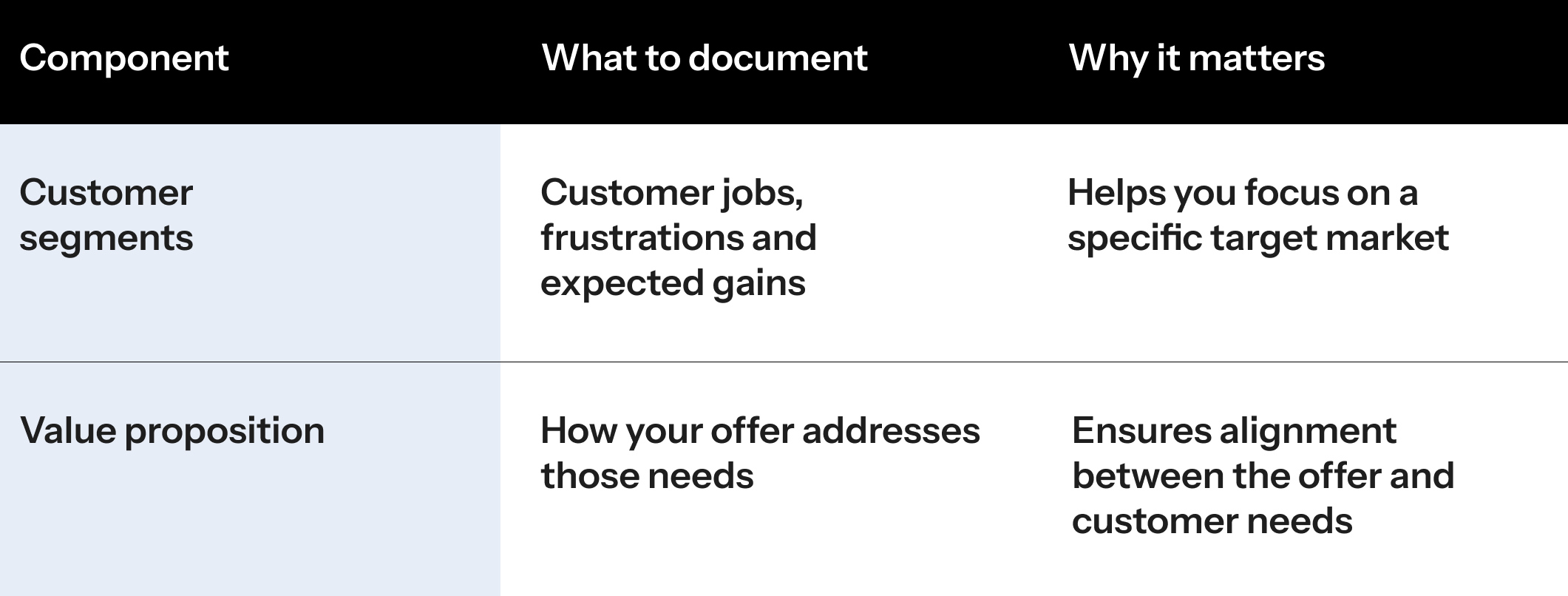
The Value Proposition Canvas (VPC) is a one-page tool that focuses on two key elements: 

  1. Your target customer 
  2. Your value proposition 

Everything depends on the fit between these two components. 

Entrepreneurs often spend most of their time improving an offer they are proud of and very little time understanding customer behaviour. PME MTL can help bring that balance back. 

The most valuable meeting you'll have: your first customer conversation 

Nothing replaces this first step. It's not a tool. It's a conversation. 

Schedule a meeting with a potential customer and ask questions about their reality. From there, you can build a more complete market analysis of your industry. 

Pre-startup tools 

These tools are primarily meant to put your ideas on paper, sharpen your focus, identify blind spots and eventually support financing applications. 

  • Value Proposition Canvas 
  • Business Model Canvas 
  • Business Plan Template 

You may also want to read our article on business plans. 

Value Proposition Canvas (2 sections, one page)

Purpose: Validates alignment between customer needs and your offer 

When to use it: During the validation stage, before anything else 

Business Model Canvas (9 building blocks)

Purpose: Maps how the business operates as a whole 

When to use it: Once the value proposition has been validated 

Business plan or pitch deck

Purpose: Serves as your roadmap and supports financing applications

When to use it: Last step, never before your first market test 

What about sustainability? 

Reducing packaging, sourcing locally, designing products that are durable or repairable: these considerations are often easier to implement when they are built into the project from the beginning. 

But just like any other aspect of your offer, they should be validated. Ask customers whether these benefits influence their purchasing decisions. 

When customers recognize their value, they become a competitive advantage. If they are never validated, they may ring hollow or even be perceived as greenwashing. 

Get out there. Book a meeting with a customer. The goal isn't to sell.

Amel Chatti

Director, Advisory Services, PME MTL Centre-Ville

FAQ: Validating a business idea

How long does it take to get initial market feedback?

You can gather useful insights in as little as an afternoon or a day of field testing. 

The goal isn't to find a definitive answer right away but rather to start collecting information. Validation is a skill that develops through practice: the more you do it, the more you learn. 

Should sustainability be considered during the validation stage?

Yes, and it's often the ideal time to do so. 

Validate whether sustainability-related benefits matter to your customers. PME MTL's sustainable business practices specialists can help guide your thinking. 

Do you need a business plan to validate a business idea?

No. The business plan comes after validation. Spending weeks writing a 50-page document before conducting your first market test may not be the best use of your time. 

At this stage, a simple pitch deck is often enough: a short presentation that helps investors, partners or customers quickly understand your project. 

A pitch deck generally includes: 

  • The problem you're solving 
  • Your solution (product or service) 
  • Your target customers 
  • Your business model (how you generate revenue) 
  • Market opportunity and competition (your competitive advantage) 
  • Your go-to-market strategy 
  • Your team 
  • Your funding needs or what you're seeking 
Où trouver de l'aide pour valider son idée à Montréal?

L'équipe de PME MTL vous accompagne dans la démarche et vous oriente vers les bonnes ressources. Parler à d'autres entrepreneur(e)s compte autant : cela rassure, inspire et met en action.

Have an idea but don't know where to start?

PME MTL's pre-startup team can help you structure your validation process, identify a first test and prepare it with confidence.

Contact
1 PME MTL Ouest-de-l'Île
2 PME MTL Centre-Ouest

PME MTL Centre-Ouest dessert les entrepreneurs des arrondissements d’Ahuntsic-Cartierville et Saint-Laurent et les villes de Côte-Saint-Luc, Hampstead, Montréal-Ouest et Mont-Royal.

Go to the area
3 PME MTL Grand Sud-Ouest
4 PME MTL Centre-Ville
5 PME MTL Centre-Est
6 PME MTL Est-de-l'Île
Territoires de Montréal Zone 1 - PME MTL Ouest-de-l'Île Zone 2 - PME MTL Centre-Ouest Zone 3 - PME MTL Grand Sud-Ouest Zone 4 - PME MTL Centre-Ville Zone 5 - PME MTL Centre-Est Zone 6 - PME MTL Est-de-l'Île